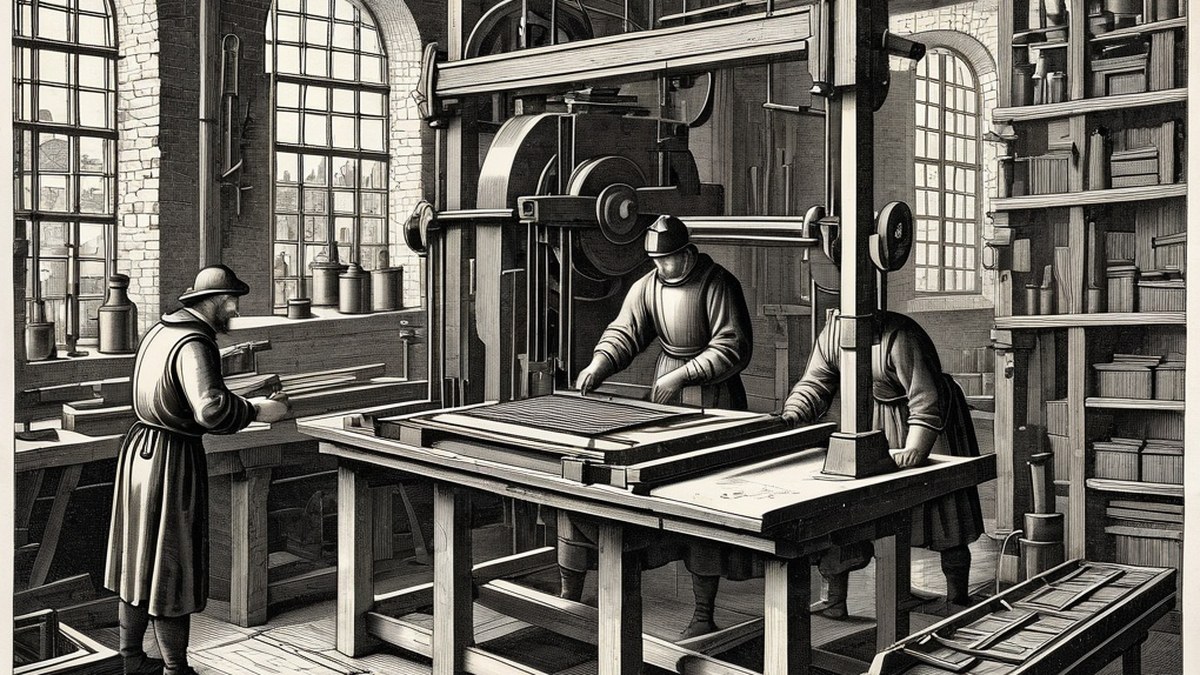
Johannes Gutenberg developed his movable-type printing system in Mainz, Germany, around 1440-1450, combining a printing press adapted from existing wine-press technology with individually cast, reusable metal type and an oil-based ink suited to printing on paper — the specific combination of innovations, rather than any single element alone, is what made the system practical and scalable. His famous 42-line Bible, printed around 1454-1455, demonstrated the technology's capability. Crucially, the technology's subsequent spread across Europe depended on a specific, documented chain of human transmission: printers trained in Mainz, or trained by others who had been, carried the knowledge and often the physical equipment to other German cities and then across Europe with remarkable speed — printing presses were operating in Italy by the late 1460s, and across most of Western Europe within roughly three decades of Gutenberg's original breakthrough, an extraordinarily fast diffusion for the period, partly accelerated by political instability in Mainz itself (including a 1462 conflict that scattered trained printers to other cities) that is sometimes credited with actually accelerating the technology's spread rather than containing it. This print revolution went on to be credited by historians with dramatically increasing book availability and affordability, significantly raising literacy rates over subsequent generations, enabling the rapid spread of Reformation ideas (including Martin Luther's own writings, printed and distributed at a scale and speed that would have been impossible by hand-copying), and generally accelerating the spread of scientific, religious, and political ideas across Europe in the following centuries.
What If the Printing Press Had Never Spread Beyond Germany?
Johannes Gutenberg's mid-15th-century printing press is routinely credited as one of the most consequential inventions in human history, enabling the rapid, affordable spread of books, ideas, and literacy across Europe. Its spread beyond Gutenberg's own city of Mainz, though, depended on specific individuals carrying the technology outward — it was never guaranteed to travel.
The History
How It Changed
Imagine the specific chain of trained printers who actually carried Gutenberg's techniques outward from Mainz in the 1450s-60s simply doesn't form — perhaps Mainz's 1462 political conflict scatters workers without transmitting the actual technical knowledge intact, or early practitioners are more successful at maintaining the technology as a closely guarded trade secret — leaving movable-type printing a known but geographically contained German innovation for considerably longer than the few decades it actually took to spread continent-wide.
The Initial Impact
Without printing's rapid spread, books would remain primarily hand-copied or produced through older, slower block-printing methods across most of Europe, meaning book production costs and availability would remain at their pre-Gutenberg levels for a region far larger and for a period far longer than actually occurred, directly constraining how quickly written ideas of any kind — religious, scientific, political — could circulate at scale.

The Local Picture
For ordinary literate Europeans outside Germany, access to books would remain genuinely limited and expensive for a much longer period, meaning literacy itself would likely spread more slowly since there would be far less affordable written material actually available to read, reinforcing a self-perpetuating cycle of limited literacy and limited text availability that Gutenberg's actual rapid diffusion specifically broke.
The Global Picture
At a broader historical level, a delayed print revolution would likely have had significant knock-on effects on several major historical developments that actually depended substantially on cheap, rapid printing: the Protestant Reformation's actual rapid spread is widely credited to Luther's ideas being printed and distributed at unprecedented speed and scale, and the broader Scientific Revolution's cumulative, collaborative progress depended heavily on researchers across Europe being able to affordably access and build on each other's published work — both could plausibly have unfolded considerably more slowly, more locally, or in a meaningfully different form without print's rapid continental spread.
Specific Predictions
The sections above build the case in general terms. Here's what that case actually implies, stated as concrete claims rather than hedged possibilities — still part of the thought experiment, not a verified forecast, but specific enough to agree or disagree with.
- European literacy rates would rise considerably more slowly over the following century compared to the actual trajectory, given how directly historians connect print's affordability and availability to broader literacy growth.
- The Protestant Reformation, if it occurred at all in a recognizable form, would likely spread far more slowly and remain more geographically contained, lacking the rapid, wide-scale printed distribution of reformist writings that actually allowed Luther's ideas to spread across Europe within just a few years.
- Scientific communication and collaboration across different European countries would develop considerably more slowly, given how dependent the actual Scientific Revolution's cumulative progress was on researchers affordably accessing printed work from elsewhere in Europe.
- Mainz and the specific German territories where printing remained concentrated would likely retain an outsized, unusual position as Europe's center of written knowledge production for considerably longer than the few decades before the technology actually spread widely.

Extreme Scenarios
These push the premise furthest — the least likely, most speculative branches worth considering precisely because they show where the reasoning starts to strain.
A different technology or transmission chain eventually spreads printing anyway, just much later
It's plausible that movable-type printing would eventually spread beyond Germany through some other channel even without the specific chain of events that actually carried it in the 1450s-60s, but potentially only after a delay of generations rather than decades — during which an enormous, hard-to-fully-calculate compounding effect on literacy, scientific progress, and the spread of ideas generally would have left much of Europe meaningfully further behind the trajectory it actually followed.
The Reformation and Scientific Revolution unfold in a fundamentally different, more fragmented form
Given how significantly both the Reformation and the Scientific Revolution's actual rapid, cross-border progress depended on cheap printed material, their absence or significant delay could plausibly have produced a meaningfully different European intellectual and religious history altogether — a more geographically fragmented, slower-moving set of religious and scientific movements, with correspondingly different political and cultural consequences across the following centuries than the ones that actually unfolded.
Related Scenarios

What If Columbus's 1492 Voyage Had Been Lost at Sea?
Columbus's crew, after five weeks with no sight of land, was on the verge of mutiny and had reportedly given him just days before turning back. Land was sighted on October 12 — perhaps three or four days before the crew's own deadline would have forced the expedition to abandon its westward course entirely.
Read the scenario →
What If Constantinople Never Fell to the Ottomans in 1453?
The Byzantine Empire, a shrunken remnant of what Rome's eastern half had once been, held out behind Constantinople's legendary walls for weeks against a much larger Ottoman army — until an unlocked postern gate, left open during a sortie, was discovered by Ottoman soldiers and gave them a way in.
Read the scenario →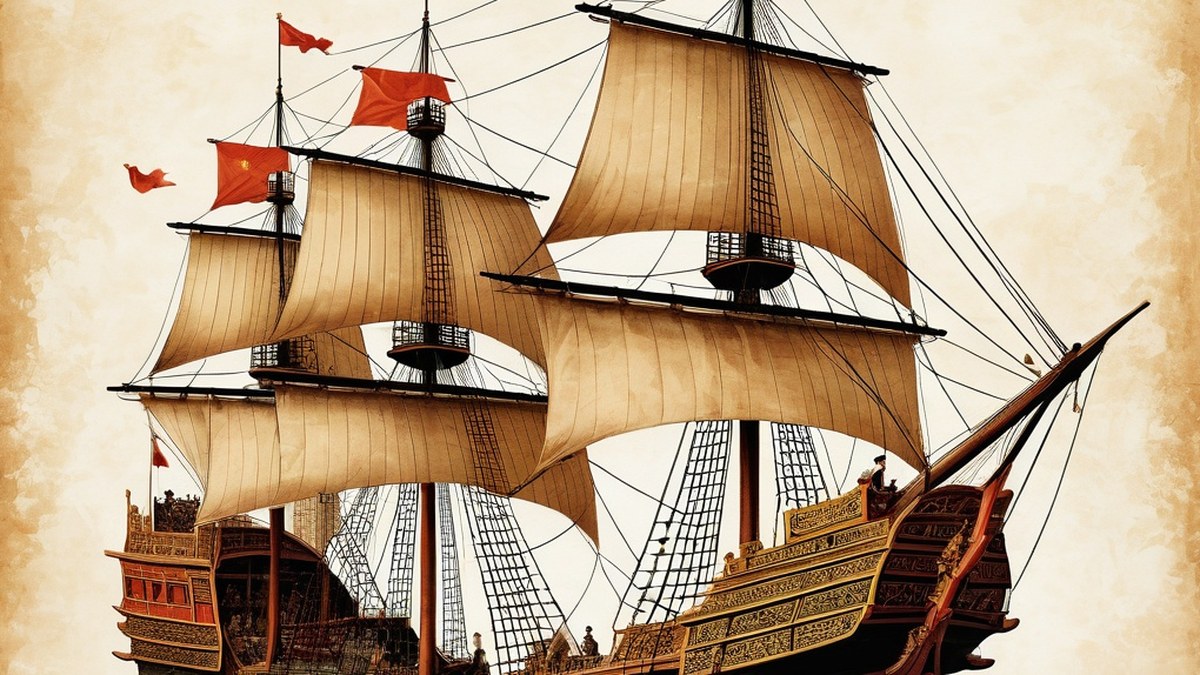
What If Zheng He's Chinese Fleets Had Reached and Colonized the Americas?
Decades before Columbus, Chinese admiral Zheng He commanded fleets of ships many times larger than anything Europe would build for another century, reaching as far as East Africa. Then a change in imperial policy ended the voyages entirely, and China turned inward for centuries.
Read the scenario →