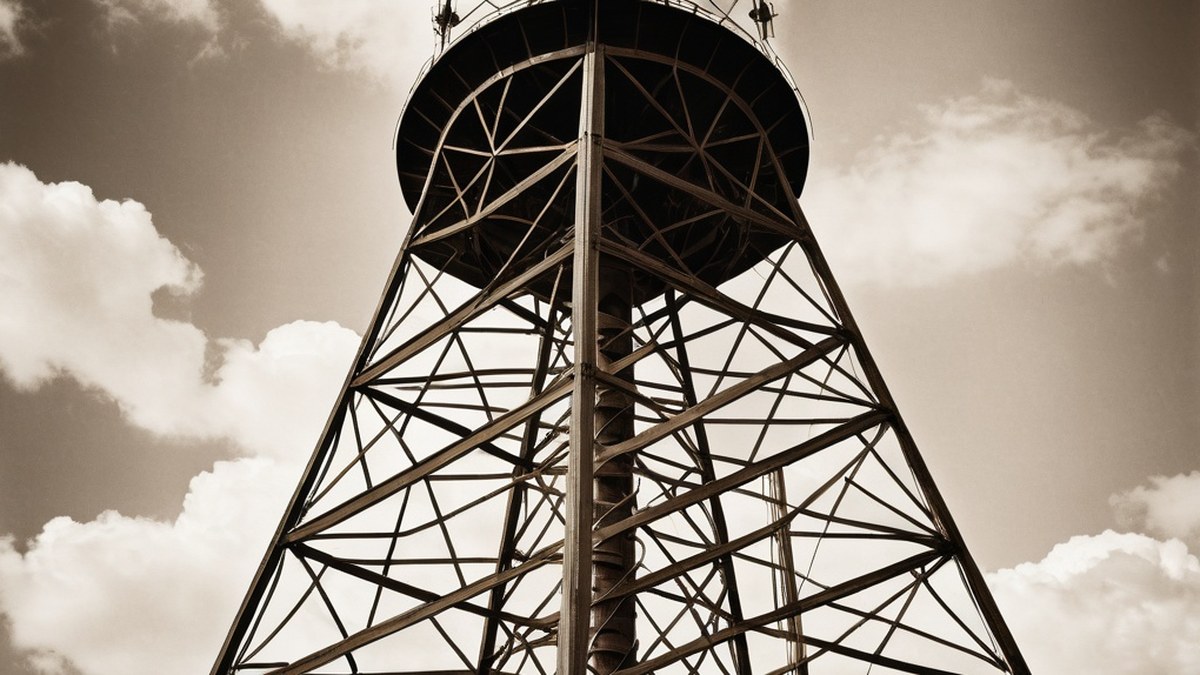
Nikola Tesla was already a central figure in the AC electrical revolution when he turned his attention to a far more ambitious idea: transmitting electrical power itself through the earth and atmosphere, without wires, to any receiver anywhere on the planet. Starting in 1901, backed by financing from J.P. Morgan, Tesla began constructing a large transmission tower at Wardenclyffe on Long Island. Morgan's investment had been made partly on the understanding that the technology could also transmit transatlantic wireless telegraph signals, a more modest and commercially comprehensible goal; when Tesla's ambitions expanded toward wireless power transmission itself — a technology that, by its very nature, would be extremely difficult to meter and bill for, since anyone with a receiver could in principle draw power without a wired connection to anyone's grid — Morgan grew uneasy and eventually withdrew further funding. Construction stalled, Marconi's rival wireless telegraph system succeeded commercially in the interim, and Tesla's tower was never completed for its original purpose. It was demolished for scrap value in 1917. Modern physics understands why long-distance wireless power transmission at the scale Tesla envisioned is extraordinarily difficult: broadcasting power efficiently over large distances through the atmosphere, rather than tightly focused short-range transmission (the kind used in today's wireless phone chargers), runs into fundamental issues with how electromagnetic energy disperses with distance.
What If Nikola Tesla's Wireless Power Transmission Had Actually Worked?
In the early 1900s, Nikola Tesla began building a tower on Long Island with the stated goal of transmitting electrical power through the earth and atmosphere without wires, to anywhere on the planet. The project ran out of money and was never completed, and the underlying physics of transmitting usable power this way, rather than just signals, remains genuinely unsolved today.
The History
How It Changed
For this thought experiment, imagine Tesla's underlying physics is sound, and Wardenclyffe is completed and successfully demonstrates genuine, efficient long-distance wireless power transmission in the 1900s — setting aside the real scientific obstacles this would have needed to overcome, since the premise here is deliberately speculative about the physics itself, not just the funding and politics around Tesla's actual project.
The Initial Impact
A working demonstration of wireless power transmission in the early 1900s would have arrived at almost exactly the moment electrical grids were being built out worldwide, creating immediate and intense competition between two completely different infrastructure models: the wired, point-to-point grid model that actually won, versus a broadcast model where power could in principle be drawn from the air by anyone with a receiver, anywhere within range of a transmission tower.

The Local Picture
For individual households and businesses, a wireless-power world would have meant a fundamentally different relationship with electricity from day one: no wiring a building to a grid, no utility poles and lines, potentially no visible infrastructure connecting a home to its power source at all beyond a receiving antenna — a genuinely different physical experience of what having electricity even looked like.
The Global Picture
At a global level, the most consequential effect would be economic and political rather than technical: if power genuinely could be broadcast and received by anyone without a wired connection, the metering, billing, and monopoly-control model that electrical utilities have been built around for over a century becomes extremely difficult to sustain, which is precisely the problem that made Morgan withdraw his real-world backing — a successful Wardenclyffe would have forced an entirely different economic model for how electricity gets paid for, likely involving some combination of government control, broadcast taxation, or entirely different utility structures than the metered grid model that actually emerged.
Specific Predictions
The sections above build the case in general terms. Here's what that case actually implies, stated as concrete claims rather than hedged possibilities — still part of the thought experiment, not a verified forecast, but specific enough to agree or disagree with.
- Electrical utility companies as a business model built on metering and billing wired connections would face an existential structural challenge, likely requiring government intervention or new regulatory models to make wireless power commercially sustainable at all.
- Rural and remote electrification would plausibly happen far faster and earlier than it actually did, since the real-world multi-decade delay in rural electrification was driven specifically by the cost of extending wires to low-density areas, a problem wireless transmission would sidestep entirely.
- National security and geopolitical concerns around wireless power transmission infrastructure would emerge quickly, given that a technology capable of broadcasting usable power over large areas raises obvious questions about who controls transmission towers and who can be denied access.
- Tesla himself would likely have become one of the wealthiest and most powerful figures of the early 20th century, reversing his actual-history decline into financial difficulty and relative obscurity in his later years.

Extreme Scenarios
These push the premise furthest — the least likely, most speculative branches worth considering precisely because they show where the reasoning starts to strain.
Wireless power becomes a nationalized global utility, reshaping 20th-century economics
Push this furthest, and a world where electrical power can be broadcast rather than wired could very plausibly see most nations nationalize wireless power transmission as a strategic utility within a few decades, given the impossibility of maintaining a purely private monopoly over broadcast energy — reshaping the basic economic relationship between citizens, corporations, and electricity in a way that never needed to happen in our wired-grid reality.
The technology remains limited to short-range applications, much as it actually has
A more sobering possibility: even with Wardenclyffe succeeding as a specific demonstration, the fundamental physics of long-distance wireless power transmission could still prove impractical to scale commercially beyond short-range applications, meaning the wired grid model wins out anyway within a few decades on pure economic efficiency grounds — Tesla's tower becomes a celebrated historical curiosity and proof of concept rather than the foundation of a genuinely different 20th-century electrical infrastructure.
Related Scenarios

What If Edison's DC Power Had Beaten Tesla's AC?
The 'War of the Currents' in the late 1880s and early 1890s decided whether the world's electrical grids would run on Thomas Edison's direct current or Nikola Tesla and George Westinghouse's alternating current. AC won decisively — but the outcome was closer, and more commercially manipulated, than most people realize.
Read the scenario →
What If Refrigeration Was Never Invented?
For most of human history, keeping food cold meant cutting blocks of ice from frozen lakes in winter and storing them, packed in sawdust, hoping they would last through summer. Mechanical refrigeration replaced this entire seasonal, geography-dependent industry within a few decades — and rewired how, and where, the world eats.
Read the scenario →
What If the Telegraph Was Never Invented?
For all of human history, a message could travel no faster than a horse, a ship, or a signal fire could carry it. Then, in a matter of decades, a network of wires made it possible to send a message across an ocean in minutes — the first time in history that information could move faster than any physical object.
Read the scenario →