Esperanto was designed from the outset to be easy to learn and, crucially, not tied to any single nation's political or cultural dominance — a deliberate alternative to using a great power's own language, such as French, as the medium of international diplomacy and commerce. It built a real, if modest, international following through the early 20th century. In 1922, a proposal was put before the League of Nations for member states to begin teaching Esperanto in schools as a standard international second language. The proposal was blocked, with France's delegation playing the leading role in opposing it, reportedly concerned about the effect on French's long-standing status as the dominant language of international diplomacy. Esperanto never gained the institutional foothold that vote would have provided, and in the decades after the Second World War, English rose to become the world's de facto lingua franca instead, propelled by the economic, military, and cultural dominance of the United States and the later global spread of computing and the internet, both overwhelmingly English-language in origin.
What If Esperanto Had Become the World's Standard Second Language?
L. L. Zamenhof created Esperanto in 1887 as a deliberately simple, politically neutral international language. It gained a genuine following and even came close to institutional adoption: a 1922 proposal to the League of Nations for member states to teach it in schools as an international second language was blocked, largely by France, which saw it as a threat to French's status as the language of diplomacy. English went on to become the de facto global lingua franca after 1945, driven by American economic, military, and cultural dominance.
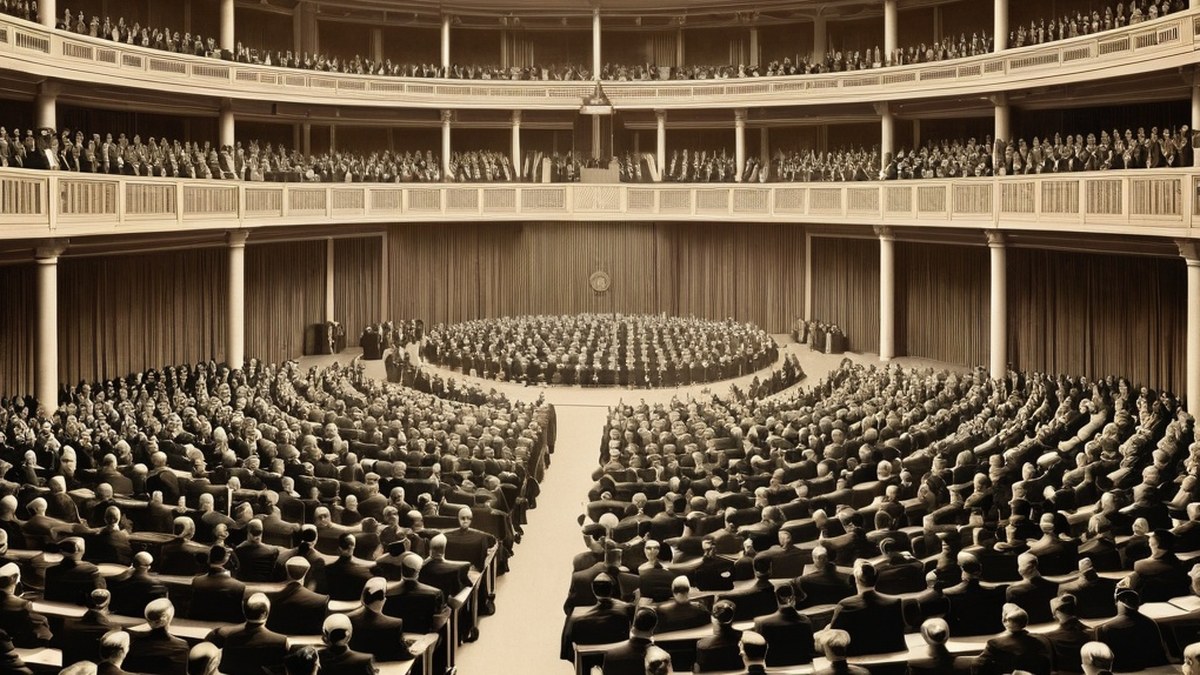
The History
How It Changed
Imagine the political climate at the League of Nations in 1922 is different enough — whether through a different French government's priorities or a stronger coalition of smaller nations backing the proposal — that the Esperanto-in-schools proposal succeeds, and member states begin incorporating Esperanto into their school curricula as a standard international second language starting in the 1920s and 1930s.
The Initial Impact
Adoption rolls out gradually and unevenly across League of Nations member states through the interwar period, with schoolchildren across many countries learning Esperanto alongside their native language, and international organizations beginning to conduct some business in it alongside national languages — a slow institutional shift rather than an overnight transformation.

The Local Picture
For ordinary students across many countries, learning a deliberately regular, constructed language becomes a normal part of schooling, rather than the national-language-of-power options (French, and later English) that actually dominated international-language education. For diplomats and international civil servants, Esperanto offers a genuinely neutral medium not carrying the prestige or resentment attached to any single great power's own language.
The Global Picture
International communication in diplomacy, science, and trade shifts away from being tied to any single national language's prestige. The Second World War and decolonization still unfold on largely the same geopolitical timeline, since Esperanto's spread doesn't change the underlying political and military dynamics driving those events — but post-war language politics look different: American economic and cultural dominance after 1945 still pushes English's influence upward, creating decades of friction between an already institutionally entrenched Esperanto and an increasingly powerful English, rather than English simply filling an open lane.
Specific Predictions
The sections above build the case in general terms. Here's what that case actually implies, stated as concrete claims rather than hedged possibilities — still part of the thought experiment, not a verified forecast, but specific enough to agree or disagree with.
- Esperanto usage would plateau as a widely-taught second language rather than fully displacing national languages — people would speak their own mother tongue plus Esperanto, similar to how English actually functions internationally today, rather than Esperanto eliminating the practical role English now plays.
- American economic and cultural dominance after 1945 would still push English's global influence upward regardless of Esperanto's educational head start, creating sustained friction between the two rather than a clean outcome favoring either.
- The internet and computing, overwhelmingly English in origin, would still exert strong pressure toward English in technical and online contexts even with Esperanto established in schools decades earlier, likely limiting Esperanto's dominance mainly to diplomatic and formal institutional settings rather than everyday technology and pop culture.
- Esperanto's literature, broadcast media, and academic study would be dramatically larger than they actually are today, large enough to support genuine publishing and media industries rather than remaining mostly a dedicated hobbyist and activist community.

Extreme Scenarios
These push the premise furthest — the least likely, most speculative branches worth considering precisely because they show where the reasoning starts to strain.
Esperanto only survives at the diplomatic and institutional level, never reaching everyday speech
In a more limited branch, Esperanto becomes genuinely entrenched in international organizations and formal diplomacy — a working language of institutions like the League of Nations' successors — but never meaningfully penetrates everyday popular culture, commerce, or technology, remaining a formal second language in the way Latin once functioned for the Catholic Church rather than becoming a truly global vernacular.
Esperanto evolves and fragments regionally, the way Latin did into the Romance languages
After a century of widespread use across very different linguistic communities, regional variants and pronunciations drift apart enough that a single, unified 'Esperanto' becomes harder to maintain — an outcome that would ironically undermine the original design goal of creating one simple, universally consistent international language.
Related Scenarios

What If Estonia's 1990s Digital Government Push Had Produced the First AI-Run State?
After regaining independence from the Soviet Union in 1991, Estonia rebuilt its government infrastructure from scratch, choosing to digitise rather than replicate the paper-based bureaucracy of its neighbours — a real, well-documented decision that produced X-Road, digital ID, and eventually e-Residency, making Estonia the world's most thoroughly digitised state government. A version of that same founding choice pointed toward AI-driven administration, not just digital administration, raises a genuinely different question.
Read the scenario →
What If the Modern Olympics Were Never Revived in 1896?
A French aristocrat, convinced that organized sport built moral and physical character, spent years persuading skeptical European sporting officials to revive a fifteen-century-dormant ancient Greek tradition. Most of them thought the idea was impractical, if not slightly absurd.
Read the scenario →
What If US Prohibition Had Never Been Repealed?
The 18th Amendment banned the manufacture, sale, and transport of alcohol across the United States starting in 1920, fueling a massive black market, the rise of organized crime figures like Al Capone, and widespread public contempt for an unenforceable law. The 21st Amendment repealed it in 1933, driven partly by Depression-era desire for tax revenue and jobs and partly by exhaustion with enforcement failures and crime. That repeal was a political choice, not an inevitability.
Read the scenario →