The Shah had ruled Iran since 1941, maintaining power partly through SAVAK, a feared secret police force, and partly through close alliance with the United States, which had helped restore him to full power after a 1953 CIA-backed coup removed a democratically elected prime minister who had nationalized Iran's oil industry. By the late 1970s, rapid but uneven oil-funded economic modernization, perceived corruption, and continued political repression had generated broad opposition across multiple, ideologically very different groups — secular nationalists, communists and leftists, and religious conservatives aligned with Shia clerics, most prominently the exiled Ayatollah Khomeini. Mass protests and strikes through 1978 and early 1979 proved impossible for the Shah's government to suppress, and he left Iran in January 1979, never to return. In the chaotic months that followed, Khomeini returned from exile and, through a combination of genuine popular religious authority, superior organizational capacity among his clerical network, and the sidelining or suppression of rival revolutionary factions, successfully consolidated control over the revolution's outcome, establishing the Islamic Republic of Iran via referendum later in 1979 and setting Iran on a dramatically different political and foreign policy course that has shaped Middle Eastern geopolitics ever since.
What If the 1979 Iranian Revolution Had Failed?
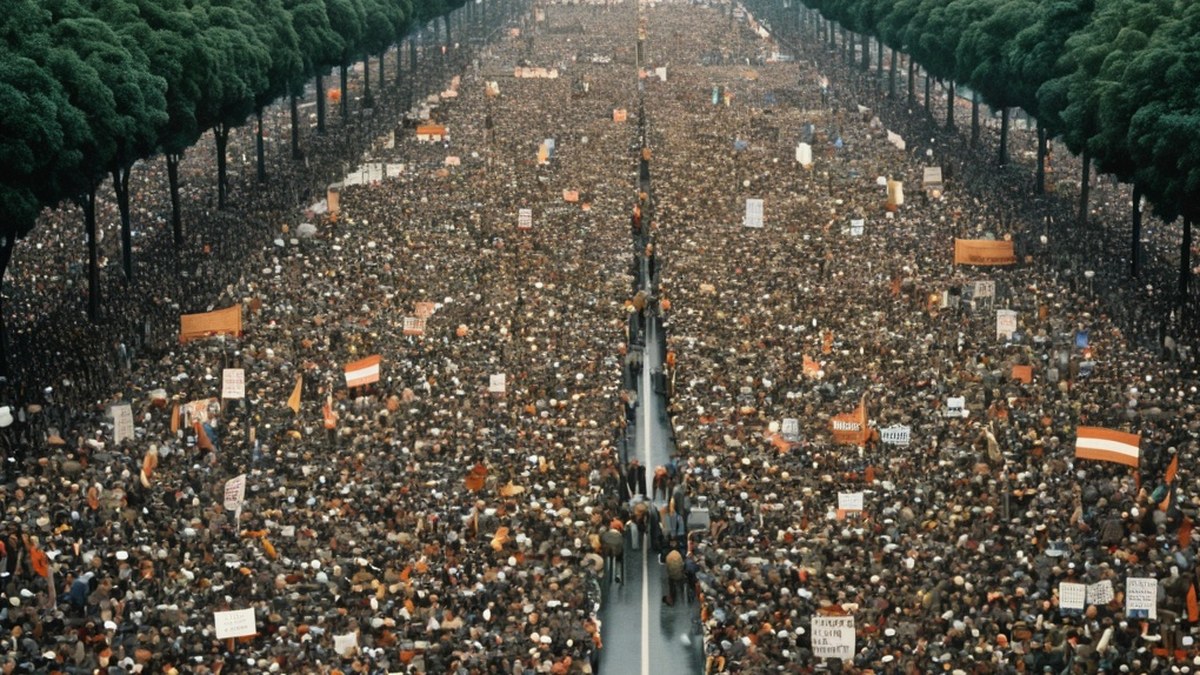
In early 1979, mass protests and strikes forced Iran's long-ruling monarch, Shah Mohammad Reza Pahlavi, into exile, ending over two thousand years of Persian monarchy. Within months, the revolution's initially diverse coalition of secular, leftist, and religious groups had been consolidated under the leadership of the exiled cleric Ayatollah Khomeini, establishing the Islamic Republic of Iran.
The History
How It Changed
Imagine the revolution's broader, more ideologically diverse coalition — secular nationalists and leftist groups who were genuinely significant forces in the actual 1978-79 protests, not simply bystanders to a purely religious movement — successfully prevents Khomeini's faction from consolidating control in the critical months after the Shah's departure, installing instead a secular or more pluralistic government, which was a real possibility actively contested at the time rather than a foregone conclusion.
The Initial Impact
A post-Shah Iran governed by a secular or pluralistic coalition rather than Khomeini's Islamic Republic would have immediately changed Iran's foreign policy trajectory, most likely avoiding the hostage crisis that saw 52 American diplomats held for 444 days starting in late 1979, an event that fundamentally poisoned US-Iran relations for the following decades and remains a defining grievance on both sides.

The Local Picture
For Iranian civil society specifically, a more pluralistic post-revolutionary government would have meant a very different domestic experience in the following decades — potentially avoiding the systematic political repression, mandatory religious dress codes, and restrictions on women's legal rights that the Islamic Republic imposed, though a secular or leftist revolutionary government of the late 1970s might well have brought its own, different forms of authoritarianism, given the broader pattern of revolutionary governments across the 20th century.
The Global Picture
At the broadest geopolitical level, the Iranian Revolution's actual outcome reshaped the entire modern Middle East: it ended Iran's role as a key American ally in the region, triggered the devastating eight-year Iran-Iraq War that began in 1980, and established a model and sometimes direct sponsor for Islamist political movements across the region that has influenced Middle Eastern politics for over four decades — a differently-concluded revolution would very plausibly have prevented or substantially altered all of these downstream consequences, fundamentally changing the shape of the region's subsequent conflicts and alliances, including the Iran-Iraq War, Iran's relationship with Gulf Arab states, and the broader regional influence of Shia political Islam as a model other movements sought to emulate.
Specific Predictions
The sections above build the case in general terms. Here's what that case actually implies, stated as concrete claims rather than hedged possibilities — still part of the thought experiment, not a verified forecast, but specific enough to agree or disagree with.
- The 1979-1981 US hostage crisis, a defining event in modern US-Iran relations, would very plausibly not occur in anything like its actual form under a differently-constituted post-revolutionary government, with significant downstream effects on US domestic politics (the crisis contributed to Jimmy Carter's 1980 electoral defeat) and US-Iran relations for decades afterward.
- The Iran-Iraq War (1980-1988), which Saddam Hussein's Iraq launched partly calculating that post-revolutionary chaos had weakened Iran's military capacity, might not occur in the same form or timing, given that a different Iranian government's perceived strength and international relationships would alter Iraq's own strategic calculations.
- Shia political Islam's emergence as an influential regional and global model, which the Islamic Republic's example directly inspired for movements and governments elsewhere, would follow a substantially different trajectory, likely delaying or altering the development of similar movements that looked to Tehran's example in the decades that followed.
- Iran's relationship with Gulf Arab states and Israel would likely remain closer to its pre-1979 alignment for a longer period, given that much of the region's actual post-1979 polarization around Iran specifically traces to the Islamic Republic's explicit ideological and foreign policy stance rather than to Iranian national interests that would persist under any government.

Extreme Scenarios
These push the premise furthest — the least likely, most speculative branches worth considering precisely because they show where the reasoning starts to strain.
A pluralistic Iran becomes a stabilizing democratic model for the region
If a secular or pluralistic post-revolutionary Iranian government successfully navigated its own internal divisions and avoided descending into a different form of authoritarianism, a large, oil-wealthy, historically significant regional power transitioning toward genuine pluralism in 1979 could plausibly have become an influential model for democratic transition elsewhere in the Middle East, a dramatically different regional narrative than the one that actually unfolded.
The underlying coalition fractures into civil conflict regardless of who initially wins
A more sobering possibility: the actual 1978-79 revolutionary coalition's ideological range — from committed Marxists to religious conservatives — was genuinely vast, and historical examples of revolutions with similarly fractured coalitions (including Iran's own aftermath, where Khomeini's government violently suppressed former revolutionary allies once in power) suggest that preventing one faction's consolidation might simply produce a different, possibly more prolonged internal power struggle or civil conflict among the remaining factions, rather than a stable pluralistic outcome.
Related Scenarios

What If South Vietnam Had Survived the Fall of Saigon?
On April 30, 1975, North Vietnamese forces captured Saigon, the capital of South Vietnam, ending the Vietnam War with a complete communist victory and the reunification of Vietnam under Hanoi's rule. The United States had withdrawn its combat troops two years earlier and, facing its own political exhaustion with the war, declined to intervene as South Vietnam collapsed.
Read the scenario →
What If the 1948 Berlin Airlift Had Failed?
When the Soviet Union blockaded all land and water routes into West Berlin in 1948, the Western Allies responded with an enormous, sustained airlift rather than military confrontation or abandonment of the city. Its success is often cited as one of the Cold War's defining early moments — but a sustained airlift of that scale was a genuinely difficult logistical undertaking that could plausibly have failed.
Read the scenario →
What If the Marshall Plan Had Never Been Implemented?
After the Second World War, the United States committed an enormous sum to rebuilding Western European economies through the Marshall Plan, a decision widely credited with Western Europe's remarkably fast postwar recovery and its political alignment with the West through the Cold War. That level of American commitment to rebuilding former allies and former enemies alike was a genuinely contested political choice, not an inevitability.
Read the scenario →