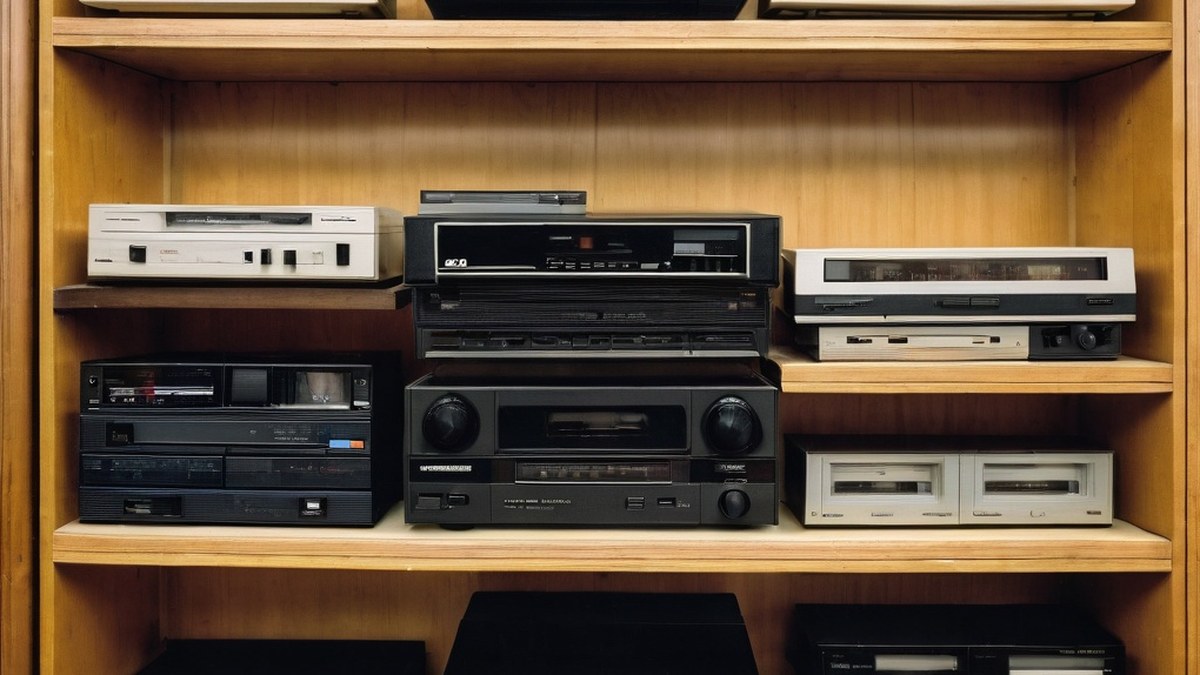
Sony launched Betamax in 1975, a year ahead of JVC's VHS. Betamax tapes produced a noticeably sharper image, and Sony kept the format tightly controlled, manufacturing the hardware itself and licensing it narrowly. JVC took the opposite approach: it licensed VHS freely to competing manufacturers including Matsushita (Panasonic), RCA, and others, flooding the market with cheaper, more varied hardware. VHS also won on recording time — Sony's early Betamax cassettes maxed out at one hour, which couldn't record a feature film or a sports broadcast, while VHS reached two hours and then longer at launch. By the early 1980s, these two factors — hardware variety driving down prices, and the ability to record a full football game or movie on one tape — had given VHS a decisive market share lead that only widened through the decade, and Sony formally discontinued Betamax production for the consumer market in 2002.
What If Betamax Had Beaten VHS in the Home Video Format War?
Sony's Betamax reached the market a year before JVC's VHS and was widely regarded by engineers as the technically superior format. It lost anyway, within about a decade, in one of the most studied format wars in consumer electronics history.
The History
How It Changed
Imagine Sony makes the opposite bet at the format's 1975 launch: open Betamax to competing licensees the way JVC actually did with VHS, and prioritize a longer initial recording time over the sharper image, matching or beating VHS on the two factors that actually decided the real format war.
The Initial Impact
A Betamax-standard home video market in the early 1980s would have looked similar in shape to the real VHS-dominated one — multiple manufacturers, falling hardware prices, a rental market built around the format — but with Sony holding a more central, controlling position than it ever achieved with Betamax in reality, given that a widely licensed Betamax would still trace back to Sony's own underlying technology and patents in a way VHS's wider JVC-led licensing network did not concentrate around any single company.

The Local Picture
For ordinary consumers, day-to-day life with a Betamax-standard VCR would have looked almost identical to real VHS-era home video — recording television, renting tapes, a wall of cassettes at the video store — since the divergence here is about market structure and corporate winners, not about any meaningfully different consumer experience.
The Global Picture
The more significant global effect would fall on Sony's own trajectory as a company: a dominant Betamax would have given Sony a far stronger grip on home video's underlying technology and royalty stream through the 1980s and 1990s, plausibly accelerating Sony's later moves into content ownership (it acquired Columbia Pictures in 1989 in our actual timeline) and giving it a stronger hand in the format wars that followed — DVD, Blu-ray, and the digital transition — where Sony's actual-history Betamax loss is often cited as a formative lesson in a company that went on to fight format wars very differently afterward.
Specific Predictions
The sections above build the case in general terms. Here's what that case actually implies, stated as concrete claims rather than hedged possibilities — still part of the thought experiment, not a verified forecast, but specific enough to agree or disagree with.
- Sony's corporate strategy through the 1990s and 2000s would plausibly be less defensively aggressive about proprietary formats, given that the real-world Betamax loss became an internal cautionary tale that shaped Sony's later licensing decisions for MiniDisc, Blu-ray, and other formats.
- JVC and Matsushita's relative standing in consumer electronics would be measurably weaker without VHS's success as a foundational product line through the 1980s.
- The DVD format transition in the late 1990s would likely still have happened on a similar timeline, since the shift to digital optical media was driven by broader technology trends rather than anything specific to the VHS-versus-Betamax outcome.
- Sony's content acquisitions (film studios, music labels) through the 1980s and 1990s would plausibly be larger and earlier, funded by a stronger home-video royalty position than the company actually had after Betamax's commercial failure.

Extreme Scenarios
These push the premise furthest — the least likely, most speculative branches worth considering precisely because they show where the reasoning starts to strain.
Sony becomes the dominant force across both hardware and content a decade earlier
Push this furthest, and a Sony that never lost the format war arrives at the content-and-hardware integration strategy it actually pursued in the 1980s and 1990s considerably earlier and from a position of much greater financial strength, potentially making Sony rather than companies like Disney or Time Warner the defining media conglomerate of the pre-streaming era.
A stronger Sony fights the DVD transition harder, delaying the format
In the harsher branch, a Sony deeply invested in a dominant proprietary videotape standard could have real incentive to slow-walk or fight the transition to DVD and later digital formats longer than it actually did, since Betamax's real-world failure left Sony with comparatively little to defend when disc formats arrived — a dominant Betamax reverses that incentive and could meaningfully delay home video's digital transition.
Related Scenarios
What If the Chernobyl Disaster Had Been Prevented?
On April 26, 1986, a safety test at the Chernobyl Nuclear Power Plant in Soviet Ukraine went catastrophically wrong, causing an explosion and fire that released massive amounts of radioactive material and became the worst nuclear power accident in history. The test that caused it was running behind schedule, poorly supervised, and proceeding despite the reactor being in an unstable, unsafe configuration.
Read the scenario →
What If Barbed Wire Was Never Invented?
A farmer at an 1873 county fair in Illinois watched a demonstration of a wooden rail fence with metal spikes attached, meant to keep cattle away from a garden. Within a few years, his own patented refinement of the idea had fenced in the entire American West — and ended the open range forever.
Read the scenario →
What If Charles Babbage's Analytical Engine Had Actually Been Built in His Lifetime?
Charles Babbage designed the Analytical Engine in the 1830s — a general-purpose, programmable mechanical computer, decades before electricity made computing practical. Ada Lovelace's notes on it describe, correctly, that it could run far more than arithmetic. Funding disputes, manufacturing precision limits, and Babbage's own difficult relationships with backers meant it was never completed before his death in 1871. In 1991, the Science Museum in London built his earlier Difference Engine No. 2 from his original designs and it worked exactly as specified, proving the concepts were sound all along.
Read the scenario →